

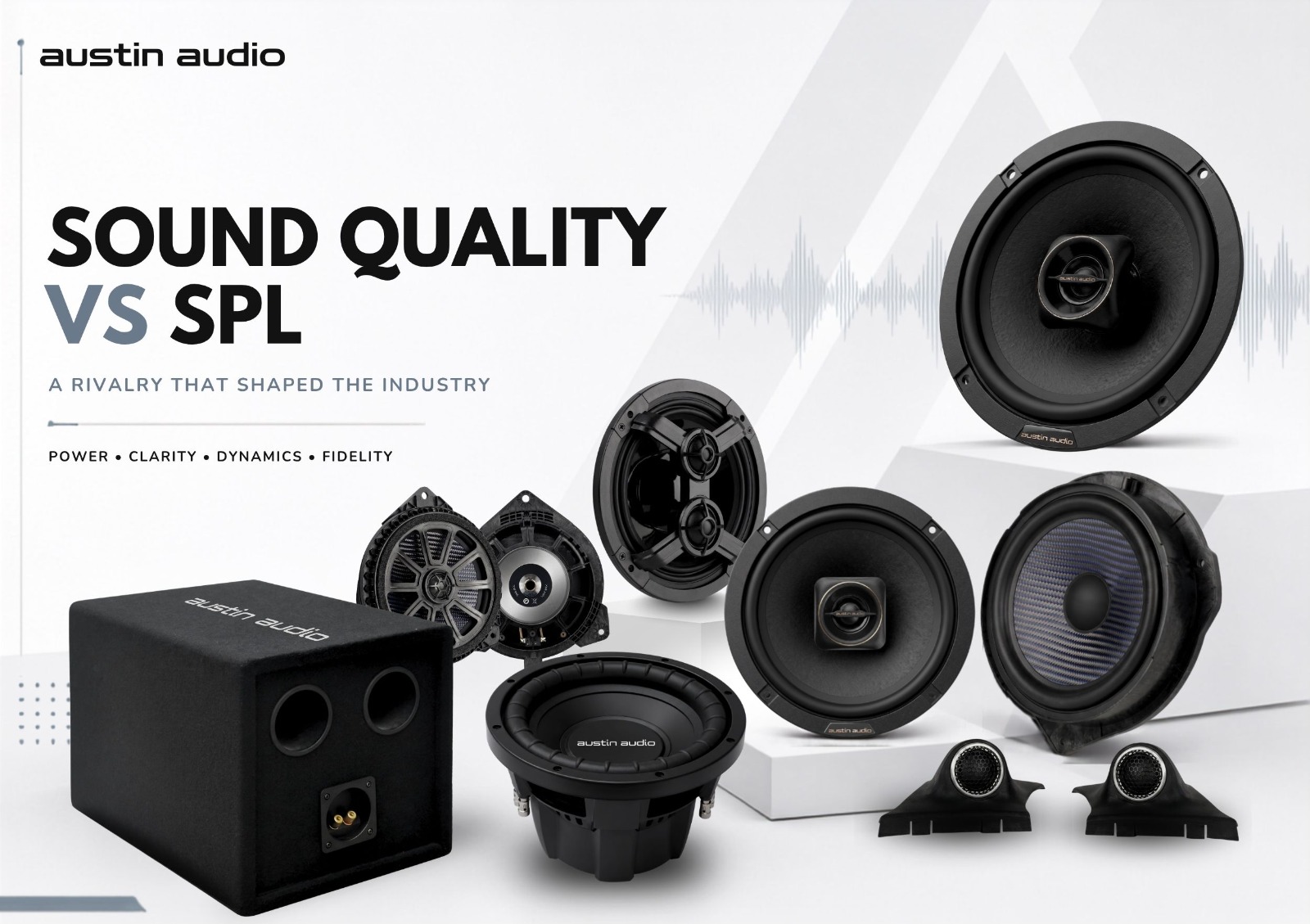
Subwoofer Enclosure Design: A Short History
By 2017, subwoofer performance was no longer judged solely by driver capability or amplifier power. The conversation had matured. Measurement tools had improved, DSP had become central to tuning, and one principle had become increasingly clear:
A subwoofer is only as good as the enclosure it operates in. This wasn’t a new idea. It was a rediscovery that traced its roots back several decades.
The Early Years: Trial, Error, and Intuition (1970s–1980s)
In the late 1970s, when car audio was still evolving, enclosure design was largely guided by intuition. Installers worked with what was available: plywood boxes, improvised dimensions, and a limited understanding of how air volume interacted with the driver.
Most systems relied on sealed enclosures, not by design preference, but by simplicity. They were forgiving, compact, and easier to build without precise calculations.
It was during this period that our origins began. In 1978, when distortion inside a vehicle cabin became the starting point of our engineering journey, it was clear that the issue wasn’t just the driver; it was the environment around it. Uncontrolled cabin resonance and poorly matched enclosures were as much a problem as the speaker itself.
The Rise of Calculation (1980s–1990s)
As the industry matured through the 1980s and 1990s, enclosure design became more scientific. The introduction of Thiele/Small parameters allowed engineers to predict how a driver would behave in a given volume of air. This led to the rise of Sealed enclosures for accuracy and Ported (bass reflex) designs for higher output
For the first time, enclosure design could be calculated rather than guessed. At Austin Audio, this period aligned with our internal focus on refining enclosure characteristics alongside driver design. The goal was not maximum output, but controlled, repeatable performance, ensuring that what was measured aligned with what was heard.
The SPL Era and Its Influence (1990s–2000s)
As car audio competitions gained popularity, enclosure design took a more extreme turn.
Large ported enclosures, bandpass designs, and high-output configurations became common. These designs prioritised: Maximum sound pressure levels and Efficiency at specific frequencies.
While effective in competition environments, many of these systems sacrificed: Linearity, Transient response and Everyday usability. This period highlighted a divide in the industry between output-driven design and accuracy-driven engineering.
The Shift Toward Integration (2000s–2010s)
By the early 2000s, vehicles themselves had begun to change. Smaller cabin spaces, Integrated interiors and Limited installation volume
Enclosure design could no longer exist in isolation. It had to adapt to the constraints of modern vehicles. This is where DSP began to play a role. Instead of relying solely on enclosure tuning, engineers could now:
- Correct the frequency response digitally
- Compensate for cabin gain
- Align subwoofers with front-stage speakers
At Austin Audio, our transition into DSP system engineering in the early 2000s reflected this shift. Enclosure design was no longer treated as a standalone variable; it became part of a complete acoustic system.
2017: Measurement Meets Practical Design
By 2017, enclosure design had reached a more balanced state. Advanced tools, such as laser-based analysis and distortion measurement platforms, allowed engineers to evaluate:
- Air compression inside the enclosure
- Port turbulence and noise
- Thermal behaviour under sustained load
The result was a return to fundamentals, but with greater precision. Well-designed sealed enclosures regained relevance for their: Predictability. Compact size and Accurate transient response. Meanwhile, ported designs became more refined, optimised not just for output, but for control and efficiency within real-world constraints.
A System-Level Perspective
One of the most important realisations by 2017 was that enclosure design cannot be separated from the rest of the system. A subwoofer enclosure interacts with:
- The driver’s mechanical limits
- The amplifier’s control
- The vehicle’s cabin acoustics
- The DSP’s tuning strategy
For example, in our own system development, enclosure volume and tuning are not selected in isolation. They are defined alongside: Driver linearity characteristics, DSP calibration profiles and Intended vehicle integration. This ensures that performance is not just theoretical but consistent in real conditions.
The Takeaway
The history of subwoofer enclosure design is not a straight progression from simple to complex. It is a cycle from intuition to measurement, from excess back to balance. By 2017, the industry had arrived at a clearer understanding:
- Bigger is not always better
- Louder is not always cleaner
- And design without measurement is incomplete
At its core, enclosure design is about control of air, movement, and resonance. Because a subwoofer does not operate in free space. It operates within a system. And the enclosure is where that system begins.